🙏 Contributors & Resources
This site stands on the shoulders of scholars, translators, and researchers who devoted years — sometimes lifetimes — to preserving and sharing the wisdom of Tiruvaḷḷuvar.
The Author
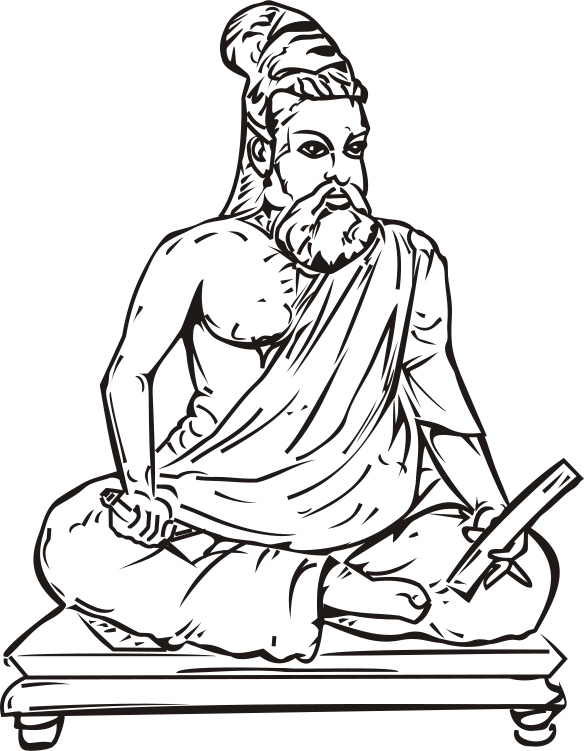
Tiruvaḷḷuvar was a celebrated Tamil poet and philosopher whose exact dates remain a subject of scholarly debate — most place him between 31 BCE and 1 CE. His masterwork, Tirukkuṟaḷ, comprises 1,330 couplets organised into 133 chapters across three books — Virtue (அறம்), Wealth (பொருள்), and Love (காமம்). Written in the highly compressed kuṟaḷ veṇpā meter, each couplet conveys profound wisdom in just seven words. The work transcends religion, caste, and culture, which is why it has been called the உலகப் பொதுமறை — the universal scripture of the world. It has been translated into over 80 languages and remains one of the most translated works of classical literature.
Tamil Commentators
Every kural on this site is accompanied by explanations from three revered Tamil scholars, each offering a distinct perspective — classical, contemporary, and rationalist. Together with Kannan's English commentary, that makes four commentaries per kural.
One of the foremost Tamil scholars of the 20th century, Mu. Varadarasanar's commentary is widely regarded as the definitive classical interpretation of Tirukkuṟaḷ. His explanations situate each couplet within the deep grammatical and literary traditions of classical Tamil (செம்மொழி), unpacking Valluvar's compressed verse with scholarly rigour and fidelity to the original meaning. His work remains the gold standard reference in Tamil universities and literary circles.
A beloved Tamil scholar and orator, Solomon Pappaiah's commentary brings Tirukkuṟaḷ to everyday readers with clarity and warmth. His explanations emphasise practical application — how Valluvar's wisdom applies to modern life, relationships, and governance. Pappaiah's accessible prose made the Tirukkuṟaḷ widely readable for a generation of Tamil speakers who found classical commentaries dense, and his lectures drew millions of listeners across Tamil Nadu.
Five-time Chief Minister of Tamil Nadu and one of the towering figures of 20th-century Tamil politics and literature, Kalaignar Karunanidhi's commentary reads Tirukkuṟaḷ through a humanist and rationalist lens. His interpretations emphasise social justice, secular ethics, and democratic values — revealing how Valluvar's ancient wisdom resonates with modern progressive thought. Written in his characteristically vivid and poetic Tamil prose, these commentaries remain a landmark of contemporary Tamil literature.
English Commentary
Every kural is accompanied by an English commentary — by Kannan for Kurals 1–1080, and by G.U. Pope as a fallback for Kurals 1081–1330.
Kannan is an independent scholar and translator who spent over seven years publishing free-verse English renditions of Tirukkuṟaḷ on his blog. His approach is deliberately modern — resisting the urge to elaborate or over-explain, while drawing on a wide range of classical commentators, especially Parimelazhagar. Where no existing commentary satisfied him, he offered his own interpretation; where multiple readings were equally valid, he provided multiple versions. His commentary is notable for its intellectual honesty and literary sensibility, particularly in the third book, Kāmaṭṭupāl, which he approached with a distinctive 5-line format to better capture its poetic character.
🔗 Read Kannan's introduction — thirukkural133.wordpress.comThe Reverend George Uglow Pope (1820–1908) was a British missionary and Tamil scholar whose 1886 translation and commentary on Tirukkuṟaḷ remains one of the most thorough and scholarly ever produced in English. Though rooted in 19th-century missionary sensibility, his explanations are meticulous and continue to be an indispensable reference. For Kurals 1081–1330 where Kannan's commentary is not available, Pope's explanations are shown.
English Translation — N.V.K. Ashraf
The English translations on this site are the result of an extraordinary 18-year research project by N.V.K. Ashraf, who systematically compared 25+ scholarly English translations of Tirukkuṟaḷ to hand-pick the finest rendering of each of the 1,330 couplets. His selection criterion was faithfulness — which translation best captures Valluvar's legendary brevity, wordplay, and spirit in English. The result is a curated best-of anthology rather than a single translator's voice.
Roughly 33% of translations come from P.S. Sundaram (Penguin Classics, 1990) — widely considered the closest to Valluvar's terseness in English. Approximately 15% are original translations by Ashraf himself. The remaining 50%+ are drawn from over 15 other translators, each credited with their initials alongside the translation.
🔗 Full methodology — kuraltranslations.blogspot.comTranslators whose work Ashraf compared & selected from:
Penguin Classics edition (1990). Ashraf's most-selected translator — praised for terseness and fidelity to Valluvar's brevity. Accounts for ~33% of the curated translations.
The pioneering 19th-century missionary scholar whose 1886 translation brought Tirukkuṟaḷ to the English-speaking world. Scholarly and meticulous, with extensive notes.
India's last Governor-General and a statesman-scholar, Rajaji's translations are elegant and readable, penned with a deep understanding of both Tamil and English literary traditions.
Revolutionary freedom fighter and Tamil scholar, Aiyar's translation captures the ethical force of Valluvar's verse with a directness that reflects his own principled character.
Where no existing translation satisfied, Ashraf produced his own — accounting for approximately 15% of the curated set. These are original renderings developed through deep comparative study.
Including W.H. Drew, John Lazarus, K.M. Balasubramaniam, and others — each contributing select renderings where their version best captured Valluvar's original intent.
Malayalam Translation
V. V. Abdulla Sahib is a Kerala-based scholar and linguist who undertook the significant work of translating Tirukkuṟaḷ's 1,330 couplets into Malayalam — bringing Valluvar's universal wisdom to one of India's richest literary traditions. Malayalam and Tamil share deep Dravidian roots, yet each has its own distinct literary character; rendering Valluvar's highly compressed kuṟaḷ veṇpā meter into Malayalam without losing its precision and depth requires both deep familiarity with classical Tamil and a refined command of Malayalam's own poetic sensibility.
Abdulla Sahib's translation is notable for its faithfulness to the ethical and philosophical dimensions of the original — preserving the secular, universal spirit of Tirukkuṟaḷ for Malayalam readers across Kerala and the global Malayalam diaspora. His contribution makes this site one of the few platforms where Tirukkuṟaḷ is accessible in Malayalam with site-wide navigation support.
Telugu Translation
Gurucharan undertook the dedicated work of translating all 1,330 Tirukkuṟaḷ couplets into Telugu, bringing Valluvar's timeless wisdom to one of India's great classical literary traditions. Telugu and Tamil share deep Dravidian roots, yet each carries a distinct literary identity; rendering Valluvar's highly compressed kuṟaḷ veṇpā verse into Telugu with fidelity to its meaning and spirit requires both mastery of classical Tamil and a refined command of Telugu's rich poetic heritage. His contribution makes Tirukkuṟaḷ accessible to the global Telugu-speaking community through this platform.
Kannada Translation
The Kannada translation on this site is drawn from ತಿರುಕ್ಕುಱಳ್ — a scholarly edition presenting the original Tamil couplets alongside word-for-word meaning and a full new-Kannada (hosagannaḍa) translation, published by the Madurai Kamaraj University Press. The translation was rendered by ಪಾ. ಶ. ಶ್ರೀನಿವಾಸ, bringing Valluvar's universal wisdom into Kannada with academic rigour and literary sensitivity. This edition stands as a significant bridge between two great classical Dravidian literary traditions.
TIRUKKURAL — with original couplets and translation in Kannada · ಅನುವಾದ: ಪಾ. ಶ. ಶ್ರೀನಿವಾಸ · ಪ್ರಕಟಣಾ ವಿಭಾಗ, ಮಧುರೈ ಕಾಮರಾಜ ವಿಶ್ವವಿದ್ಯಾನಿಲಯ
Hindi Translation
The Hindi translation presented here is that of M. G. Venkatakrishnan, whose rendering of all 1,330 Tirukkuṟaḷ couplets into Hindi was first published in 1964 — one of the earliest and most comprehensive Hindi translations of the Kural text. Hindi, being India's official link language, had attracted many translators, but Venkatakrishnan's edition distinguished itself through its fidelity to Valluvar's terse philosophical style. The second edition, published in 1998 after more than 30 years, was made possible through the generous patronage of N. Mahalingam of Sakti Finance Ltd, Chennai, and was published by Sakti Finance Ltd. His work has since served as a source text for further translations — the Odia translation by G. N. Das, for instance, is directly based on Venkatakrishnan's Hindi rendering.
M. G. Venkatakrishnan (Translator) · First edition: 1964 · Second edition: 1998 · Publisher: Sakti Finance Ltd., Chennai · Supported by N. Mahalingam
French Translation
The French translation reproduced here is that of Gnanou Diagou, who translated the entire work in 1942. First published in Pondichery, this translation is now available as an Asian Educational Services reprint from New Delhi and Madras. Diagou's translation holds a distinguished place in the francophone reception of Tamil literature — it was among the earliest complete French renderings of Tirukkuṟaḷ, produced in the context of Pondichery's unique Tamil-French cultural milieu, and remains a landmark work bringing Valluvar's universal wisdom to the French-speaking world.
Kural — Traduction française complète · Gnanou Diagou · Première édition: Pondichéry, 1942 · Réimpression: Asian Educational Services, New Delhi & Madras
Chinese Translation
The Mandarin Chinese translation on this site is the work of Dr. Yu Hsi (born Hung Ching Yu, 16 March 1951), a Taiwanese poet, Buddhist abbot and scholar who has devoted decades to building cultural bridges between Tamil and Chinese literary traditions. Born in Fangyuan Township, Taiwan, Yu Hsi holds a doctorate in letters and has authored more than 60 books. He is the founder and president of the Tamil Sangam in Taiwan — the first of its kind on the island.
Yu Hsi's translation of Tirukkuṟaḷ into Mandarin was undertaken at the personal request of former President of India Dr. A. P. J. Abdul Kalam, who presented him with a copy of the Kural at a meeting in Chennai and asked him to bring its wisdom to the Chinese-speaking world. Yu Hsi completed the translation and it was first published in Taipei, Taiwan in 2010 by Poem Culture Corp. A second edition was reprinted in India in 2014 by the Department of Tamil Development and Culture, Tamil Nadu — released by Dr. Abdul Kalam himself. In a remarkable gesture, Dr. Kalam presented a limited-edition copy (serial number 001) of Yu Hsi's translation to Taiwan's President Ma Ying-jeou at the Presidential Residence in Taipei.
Yu Hsi has also translated the poems of Subramaniya Bharathi, Bharathidasan and Avvaiyar's Aathichoodi into Mandarin. He has received numerous honours including the Thiruvalluvar Award (2014) and the Poet Laureate award from the Seoul World Academy of Arts and Culture (2004). He installed a life-size statue of Thiruvalluvar in Taiwan. Of his translation, Yu Hsi said: "I acknowledge the Tirukkural as a universal scripture — there is no specific reference to any particular race, religion, country or rule."
திருக்குறள் — மாண்டரின் மொழிபெயர்ப்பு · Dr. Yu Hsi (洪清宇) · முதல் பதிப்பு: Poem Culture Corp, Taipei, 2010 · இந்திய மறுபதிப்பு: தமிழ் வளர்ச்சித் துறை, தமிழ்நாடு, 2014
Arabic Translation
The Arabic translation on this site is the earnest work of Dr. Yousuf Kokan, who translated the entire 1,330 couplets of Tirukkuṟaḷ into Arabic — apparently from an English translation of the original Tamil. His dedication to bringing Valluvar's universal wisdom to Arabic-speaking readers represents a significant contribution to the global reach of the Kural.
The electronic version of this translation was made possible through the efforts of Dr. N.V. Ahmed Unni, whose work in converting the hard copy into digital form was invaluable. The electronic manuscript was then meticulously proofread — word by word — by Dr. C. Saidalavi, Professor and Head of the Department of Arabic, Unity College, Manjeri, Kerala, who took great pains to verify it for errors. Their combined effort has ensured the accuracy and accessibility of this Arabic rendering for the digital world.
Dr. Yousuf Kokan (Translator) · Digitised by Dr. N.V. Ahmed Unni · Proofread by Dr. C. Saidalavi, Dept. of Arabic, Unity College, Manjeri, Kerala
Russian Translation
The Russian translation featured on this site is the work of Vithali Furniki (Виталий Фурник), a scholar affiliated with the Center for the Study of Indian Culture, Moscow. His translation was made directly from Tamil — not through an intermediary language — and was published by the Vasanta Library of Popular Literature, Moscow, 1991. It is one of the rare complete Russian renderings of Tirukkuṟaḷ, brought out at a time when Soviet Orientalist scholarship had a sustained interest in classical Indian literature.
The Tirukkuṟaḷ has a long connection with Russian intellectual life. Leo Tolstoy is known to have read the Kural through a German translation, and its ethical philosophy — particularly its ideas on non-violence — is said to have influenced his moral thinking, which he later conveyed to Gandhi. The first notable Russian translation was by the Tamil scholar J. J. Glazov. Furniki's later direct Tamil-to-Russian rendering renewed this scholarly tradition.
Виталий Фурник (переводчик с тамильского) · Васантская библиотека массовой литературы · Москва, 1991 · Центр изучения индийской культуры
German Translation
The German translation on this site is by Albrecht Frenz, a German Indologist specialising in Tamil literature, in collaboration with K. Lalithambal. Their complete translation of all 1,330 Tirukkuṟaḷ couplets — Tirukkural von Tiruvalluvar — was published by Galaxy Press, Madurai, in 1977. It remains one of the most important modern German renderings of the Kural, making Valluvar's wisdom accessible to German-speaking readers across all three books: Virtue (Aram), Wealth (Porul), and Love (Inbam).
German has a distinguished history with the Tirukkuṟaḷ — it ranks among the European languages with the most translations of the Kural. The first complete German translation was made by the Lutheran missionary and Indologist Karl Graul in 1856. Scholar Kamil Zvelebil wrote of it: "As far as I know, the two best translations of Tirukkural had been till this day, Graul's old German version and V. V. S. Iyer's." Graul himself described the Kural as "an apple of gold in a network of silver." Frenz and Lalithambal's 1977 edition continues this tradition for the modern era.
Albrecht Frenz & K. Lalithambal (Übersetzer) · Tirukkural von Tiruvalluvar · Galaxy Press, Madurai, 1977
Sinhala Translation — සිංහල
තිරුවල්ලුවර්ගේ කූරල් · දෙමළ කාව්යයේ සිංහලානුවාදය
This Sinhala translation of Tirukkuṟaḷ was rendered by G. Misihami, with assistance from Dr. S. Tambayah. Published by Anula Press (අනුල මුද්රණාලය), Colombo 10 in 1961. It stands as one of the earliest and most significant Sinhala renderings of Valluvar's classic, bringing this universal Tamil wisdom to Sinhala-speaking readers across Sri Lanka. The translation preserves the couplet structure of the original while rendering the meaning faithfully in Sinhala verse.
Polish Translation — Polski
Świeta księga południowych Indii — Ossolineum, 1977
Bohdan Gębarski's Polish rendering of Tirukkuṟaḷ — titled Świeta księga południowych Indii (The Holy Book of South India) — was published in 1977 by Ossolineum, one of Poland's oldest and most prestigious publishing houses, founded in 1817 in Wrocław. This landmark publication was among the earliest translations of Tirukkuṟaḷ into any Eastern European language, bringing Valluvar's classical Tamil wisdom to Polish readers during a period when interest in South Asian philosophy and literature was growing in European academic circles. Gębarski's work required not only deep philological skill but also the ability to render the dense, aphoristic quality of the kuṟaḷ veṇpā meter into a European literary tradition — a formidable translation challenge that he met with scholarly rigour.
Swedish Translation — Svenska
Sydindisk levnadsvisdom, statskunskap och kärlek — 1330 epigram av tamilskalden Tiruvalluvar
Yngve Frykholm's Swedish interpretation is titled Sydindisk levnadsvisdom, statskunskap och kärlek — "South Indian Wisdom of Life, Statecraft and Love" — a subtitle that elegantly captures the three books of Tirukkuṟaḷ: Virtue (அறம்), Wealth (பொருள்), and Love (காமம்). Frykholm rendered all 1,330 epigrams of the Tamil poet Tiruvaḷḷuvar into Swedish verse, making the Tirukkuṟaḷ accessible to Scandinavian readers in their own literary idiom. The translation reflects a European humanist reading of Valluvar's universal ethics — finding resonance between ancient Tamil philosophy and Scandinavian values of equity, restraint, and civic virtue.
Malay Translation — Bahasa Melayu
Tamil klasik kuno · Thirukkural · Kitab Murni
G. Soosai's Malay translation, published under the title Kitab Murni (The Pure Book), brings Tirukkuṟaḷ to Bahasa Melayu — one of the world's most widely spoken languages, with over 290 million speakers across Malaysia, Indonesia, Brunei, and Singapore. Soosai's work is described on its title page as Tamil klasik kuno (Ancient Tamil Classic), situating Valluvar's text firmly within the canon of world classical literature. The translation holds particular significance given the deep historical ties between Tamil communities and the Malay world — Tamil traders, scholars, and settlers have been part of the Malay Peninsula for over two millennia. Kitab Murni makes this shared heritage explicit, presenting Valluvar's ethical and philosophical wisdom in the language of the region's majority culture.
Site Development
Built and maintains this free, ad-free web application dedicated to making Tirukkuṟaḷ accessible to readers worldwide. The site is built with pure vanilla JavaScript — no frameworks — keeping it fast and lightweight. Features include 14-language navigation, one-click Google Translate for 100+ languages, three Tamil commentaries per kural, N.V.K. Ashraf's curated English translations, dynamic SEO, and a fully responsive design for mobile, tablet, and desktop. All 1,330 kurals are available free, without ads or paywalls.
🔗 Source code — github.com/gowdhamankarthikeyan/TirukkuralWant to Contribute?
This is an open, community resource. Contributions are welcome in several ways:
- Improve translations — If you find a better English rendering for any kural, open a GitHub issue with the kural number, current text, and suggested alternative with source.
- Add a language — Fork the repo, add your language to
translations.json, and submit a pull request. No code changes required. - Report bugs — Open a GitHub issue with your browser, OS, and steps to reproduce.
- Suggest features — Open a GitHub issue with the prefix "Feature:"
Further Reading & External Resources
The following sites are independent resources we respect and recommend. We do not own or operate them — we simply believe they add value for anyone who wants to explore Tirukkuṟaḷ deeper.
A pioneering open-access initiative digitising Tamil literary works since 1998. Their Tirukkuṟaḷ etexts include multiple English translations and the classical commentary of Parimelazakar — all freely available.
Operated by the Tamil Virtual Academy, this is one of the largest digital repositories of Tamil texts. Their Tirukkuṟaḷ collection spans rare manuscripts, classical commentaries, and translations into multiple languages including Arabic.
Individual researchers and enthusiasts who have dedicated personal effort to Tirukkuṟaḷ.
An AI-powered conversational interface that lets you ask any question about the 1330 verses and receive contextual answers drawn from the text.
Scholarly blog by N.V.K. Ashraf with deep essays on Tirukkuṟaḷ — covering Jaina influences, comparative world literature, and introductions to the text in 19 languages including Arabic, Chinese, Fijian and Latin.
A vast archive by the same author presenting complete Tirukkuṟaḷ translations in 26 languages — from Hindi, French and Russian to Korean, Indonesian and Konkani — each translation presented chapter by chapter.
A curated list of fascinating and lesser-known facts about the text — its structure, reach, and global recognition.
An intriguing article exploring the deliberate omissions and implied meanings in Tiruvaḷḷuvar's tightly compressed couplets.
A detailed account of what is known — and debated — about the life, era, and identity of the poet behind Tirukkuṟaḷ.
A clean, multilingual Tirukkuṟaḷ reader available in 14 languages including Tamil, Hindi, German, Russian and Chinese — with dark mode support.
A chapter-by-chapter study blog walking through all 133 adhikarams with notes on themes, context and meaning.